Missed Call Text Back for Dentists: Stop Losing Bookings
Missed Call Text Back for Dentists: Stop Losing Bookings
Every time your dental office misses a call, there's a real chance that patient never comes back, not because they're frustrated, but because they already called someone else. Industry data consistently puts the figure around 67% of callers who reach voicemail contacting a competing practice instead of trying again. That's not a theoretical leak. That's walk-out revenue, happening daily.
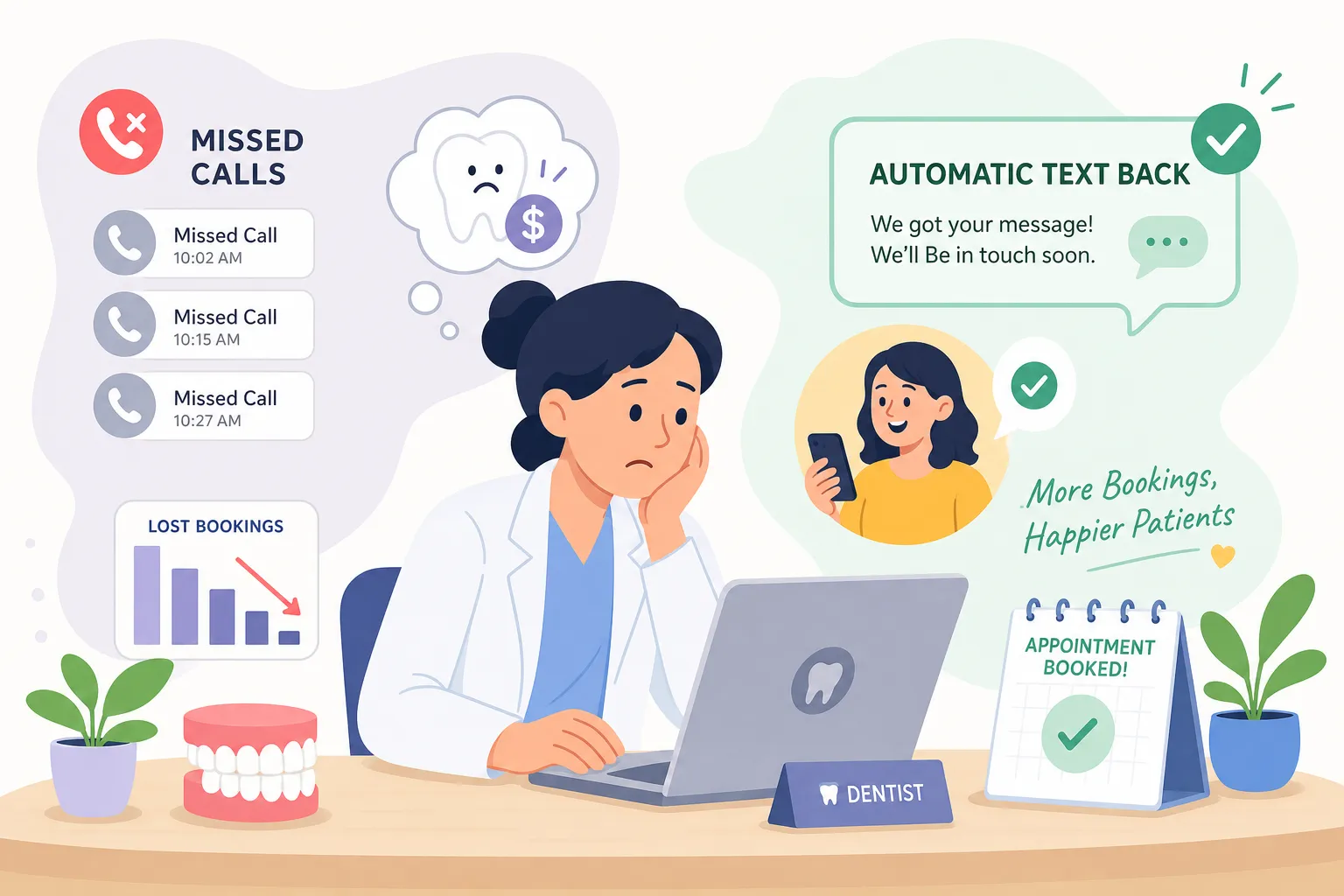
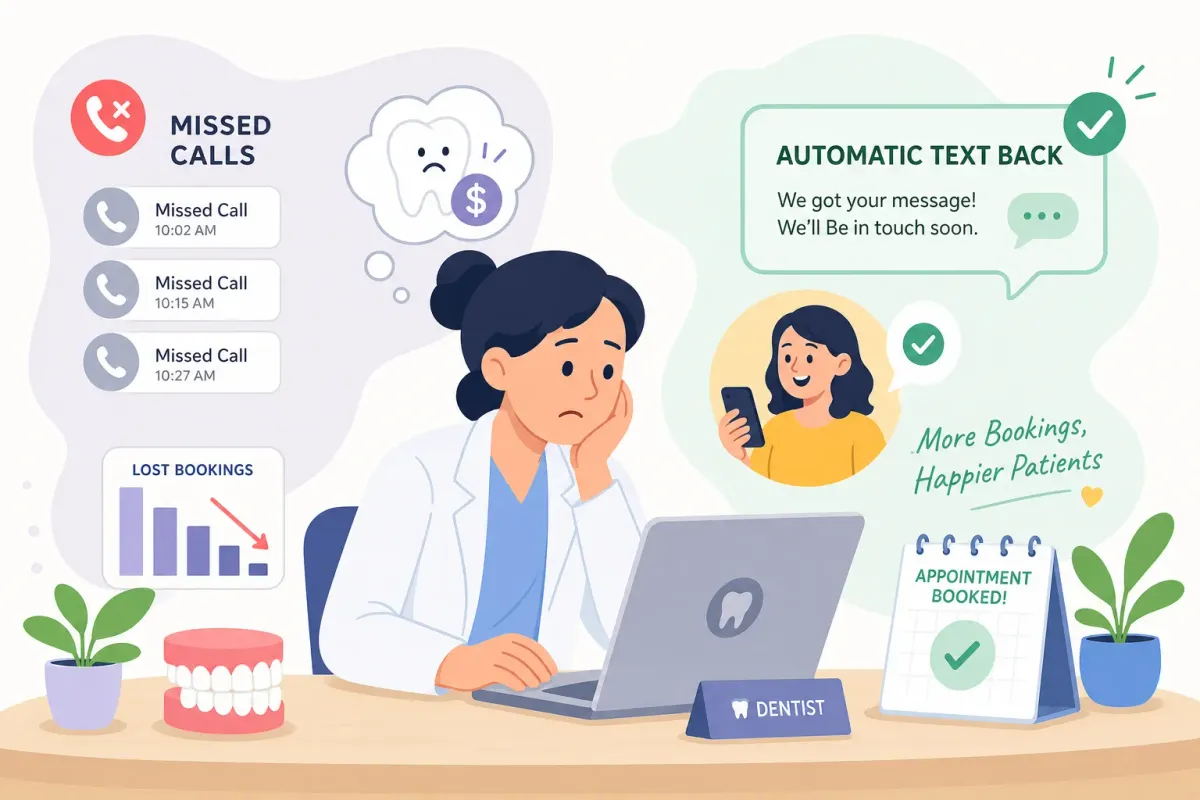
Most practices assume the voicemail will hold. It won't. The patient who hit voicemail often looks for another provider within minutes. The window to recover them is measured in minutes, not hours, research consistently shows that after an hour, the likelihood of getting that patient back drops sharply. A missed call text back dental solution changes that math entirely. When a text arrives within 60 to 90 seconds of a missed call, identifying your practice and offering a clear next step, you re-enter the conversation before it moves elsewhere.
This article gives you what you need to evaluate a missed call text back dental system, choose one that's HIPAA-compliant, set up message templates that actually book appointments, and measure whether the system is pulling its weight.
What a missed call actually costs your practice
The average solo dental practice misses 8 to 15 inbound calls per business day. At five days a week, that's 40 to 75 missed opportunities every week. Each one represents a person who looked up your number, picked up the phone, and called. That's not a cold lead. That's a warm one, already in motion.
The actual numbers behind a single unanswered call
Consider a new patient who comes in for a cleaning, gets X-rays, and returns twice a year. Conservative industry estimates put that relationship at $600 to $1,000 annually in production. Over five years, that's $3,000 to $5,000 from a single booking. One missed call without follow-up isn't a $300 lost appointment. It's a five-year patient relationship that never started.
Why "they'll call back" is rarely true
About 78 to 86% of callers who reach voicemail don't leave a message. They hang up and move on. The realistic recovery window sits between 5 and 30 minutes. Waiting for a callback isn't a strategy. It's wishful thinking with a real dollar cost attached.
How missed call text back dental systems work
The technology behind missed-call recovery is straightforward. A missed call triggers an automated response. That response arrives as a text message within seconds. The patient replies or clicks a booking link, and the conversation either closes as a booked appointment or routes to staff for follow-up. Speed applied at the right moment, that's the entire concept.
The trigger-to-text workflow in plain terms
Four things happen in sequence:
Your phone system detects an unanswered call.
It passes the caller's number to the text-back platform via a webhook or API.
The platform sends an SMS to that number.
The caller receives a message they can reply to or click from.
In a well-configured system, that entire chain can complete in under a minute. That's the mechanical picture.
What response speed actually changes
Speed is the variable that determines whether the patient stays in your orbit or opens a competitor's website. A text that arrives within 60 to 90 seconds of a missed call catches a patient who is still deciding. Contrast that with a 15-minute callback, which typically reaches someone who has already started shopping elsewhere. The gap between fast automation and a delayed callback isn't a minor timing difference. It's the difference between a booked appointment and a lost patient.
Missed call text back dental: response benchmarks and conversion rates
Conversion claims in this space are frequently inflated. It's worth understanding what the numbers actually represent before you hold a vendor accountable to them.
What the timing data actually shows
During business hours, the goal is a text within 60 to 90 seconds, with a human callback within 15 minutes when possible. After hours, send an immediate acknowledgment with office hours and a booking option, no callback promises you can't keep.
On conversion rates: basic SMS text-back without much configuration produces around 5 to 12% of missed calls becoming booked appointments. A well-configured, instant text-back system lands in the 20 to 30% range. High-performing setups with real-time booking links and fast follow-up can reach 30 to 40% or better. A practical planning number is 20 to 25 recovered appointments per 100 missed calls. Hold vendors to that benchmark.
After-hours calls and the suppression rules that protect compliance
Suppress routine messages before 8 a.m. and after 8 p.m. unless the patient has opted into those hours. After-hours missed calls get an acknowledgment text, not a booking push. Urgent calls should never rely on automation alone. Any message that sounds like a clinical response to a symptom crosses a line that automation isn't equipped to handle. Staff triage stays essential, especially for emergency calls where a delayed human response can have real consequences.
SMS templates and CTAs that actually book appointments
Here are the five message formats that consistently produce the highest reply and booking rates. Use them as a starting point, then adjust for your practice's voice and scheduling workflow.
The five message formats with the highest conversion
1. Immediate reply-or-book: "Hi [First Name], this is [Practice Name]. We just missed your call. Reply here with your question, or book a convenient time: [Link]." Works because it's fast, identifies the practice, and gives one action to take.
2. New-patient qualification: "Hi [First Name], sorry we missed you at [Practice Name]. Are you a new patient or calling to schedule? Reply NEW or APPT and we'll help." Useful when routing matters and new-patient workflows differ from existing-patient requests.
3. Callback-time choice: "Hi [First Name], [Practice Name] here. We missed your call. We can call you at [time 1] or [time 2]. Reply 1 or 2." Giving concrete options reduces friction more than asking the patient to propose a time on their own. Most patients pick one immediately rather than thinking through alternatives.
4. Direct booking link: "Hi [First Name], sorry we missed you at [Practice Name]. Schedule online here: [Link]. Or reply CALL and we'll reach out." Use this only when the booking page shows real, near-term availability on mobile. A link to a calendar with no open slots in the next two weeks kills the conversion.
5. Human follow-up for no reply: "Hi [First Name], following up from [Practice Name]. We'd still like to help. Prefer a call today or a booking link?" Send this after 2 to 4 hours if the first message gets no response. Don't let silence sit longer than that.
CTAs ranked by how easy they are for a patient to act on
Easiest to hardest: "Reply 1 or 2," "Reply BOOK," "Tap to book: [Link]," "Reply NEW or APPT," "Reply YES." Never use vague CTAs like "Let us know how we can help." One CTA per message, always. Keep it under 160 characters where possible, but clarity beats character count every time.
HIPAA compliance and PMS integration: what to verify before you commit
A text-back system that routes patient data through an unsecured channel creates real liability. A vendor's general claim of HIPAA compliance means nothing if their plan doesn't include a signed Business Associate Agreement that specifically covers SMS and call data.
What HIPAA-compliant missed-call texting actually requires
Before signing with any vendor, confirm these are in place:
A signed BAA covering SMS and call data
No protected health information in the SMS body
A two-way texting number that accepts replies
Encryption in transit and at rest
Opt-out handling and audit logs
Treatment-related messages, including appointment reminders and confirmations, may qualify for the HIPAA healthcare-treatment exemption under TCPA when sent by a covered entity with appropriate consent and controls in place. Marketing or promotional texts require prior written consent. When in doubt, document opt-in at intake. State-specific requirements can add another layer. Get legal eyes on your message templates before launch.
Integrating with Dentrix, Eaglesoft, and Open Dental
Dentrix often requires a local server connector because it runs as a locally hosted system. Open Dental's API-based architecture supports bidirectional booking natively. Eaglesoft frequently bridges through middleware like NexHealth, which abstracts differences across PMS platforms.
The critical distinction is read-only versus bidirectional. A read-only integration shows availability. A bidirectional integration actually books appointments, confirms them, and logs the conversation in the patient record. Look for systems with native dental PMS connectors. A generic CRM integration that claims compatibility is not the same thing as real-time, two-way synchronization with your scheduling system.
How to measure whether your text-back system is working
Setting up automation and walking away is the most common mistake practices make. Four metrics tell you whether the system is performing or just sending texts nobody acts on.
The four metrics that matter
Reply rate: What percentage of missed-call texts get a response
Booking rate: Replies that turn into scheduled appointments
Show rate: Those appointments that actually happen
Time-to-text: How fast the automation fired after each missed call
The business metric is showed appointments, not delivered texts. High delivery numbers with low bookings almost always point to a CTA problem or a broken booking link.
What good looks like at 90 days
A well-configured system should produce 20 to 30 recovered appointments per 100 missed calls within the first 90 days. If reply rate is high but booking rate is low, the CTA or booking link is the problem. If both are low, the message timing or copy needs adjustment.
Verify performance against your own data, not just what a vendor reports. The 20 to 25 recovered appointments per 100 missed calls is the industry benchmark, measure your actual results against it and adjust from there. OPWDIGITAL builds 90-day performance benchmarks into their reporting for dental practices, giving you real outcome tracking rather than guesswork.
Missed call text back dental: is it the right move for your practice?
Missed calls are recoverable revenue. The technology to capture them is available, purpose-built for dental practices, and significantly cheaper than the paid-search campaigns most practices run to generate new patient calls in the first place. Missed-call text-back automation typically costs a fraction of what it costs to acquire a patient through paid advertising, because the patient already called. You're not generating demand. You're recovering it.
Start by pulling your missed-call volume for the last 30 days. Run the revenue math using your actual new-patient lifetime value. Then evaluate any vendor through the HIPAA and PMS integration checklist above. Three criteria matter most: a signed BAA, bidirectional PMS sync, and a response time of 60 to 90 seconds or faster. Vendors who can't confirm all three aren't ready for a dental practice environment.
OPWDIGITAL focuses exclusively on dental practices that are done losing bookings to unanswered calls. If you want to see how a missed call text back dental system fits your practice's call volume and scheduling setup, reach out to the OPWDIGITAL team directly. The audit takes less time than the next call you'll miss without it.