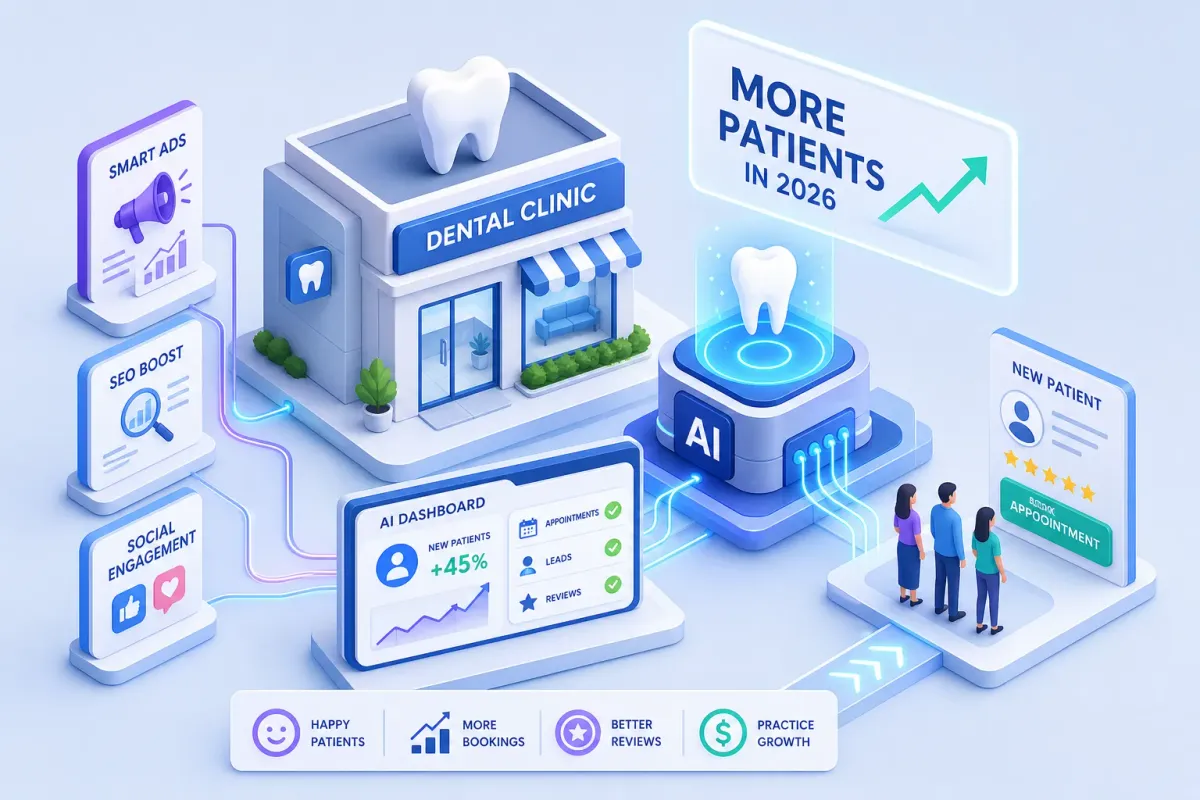
How AI Helps Dental Offices Get More Patients in 2026
How AI Helps Dental Offices Get More Patients in 2026
How can AI help a dental office get more patients? For many practices, the answer starts with a missed phone call. The prospective patient called during lunch, hit voicemail, and booked an appointment at the practice down the street before your front desk finished eating. Missed and unanswered calls are one of the most common sources of lost new-patient opportunities, and most practice owners never see it happening because the data simply doesn't exist. You can't track a patient who never left a message.
Patient demand isn't the issue. In most markets, people need dental care. The problem is that the systems most practices rely on, a front desk with fixed hours and a voicemail box nobody checks fast enough, were built for a different era. AI is filling that gap in 2026, not as a novelty, but as infrastructure. Platforms purpose-built for dental AI patient acquisition are now handling inbound inquiries, recovering missed calls, automating follow-ups, and generating reviews around the clock. This article covers what those tools actually do, what they cost, and how you measure whether they're working.
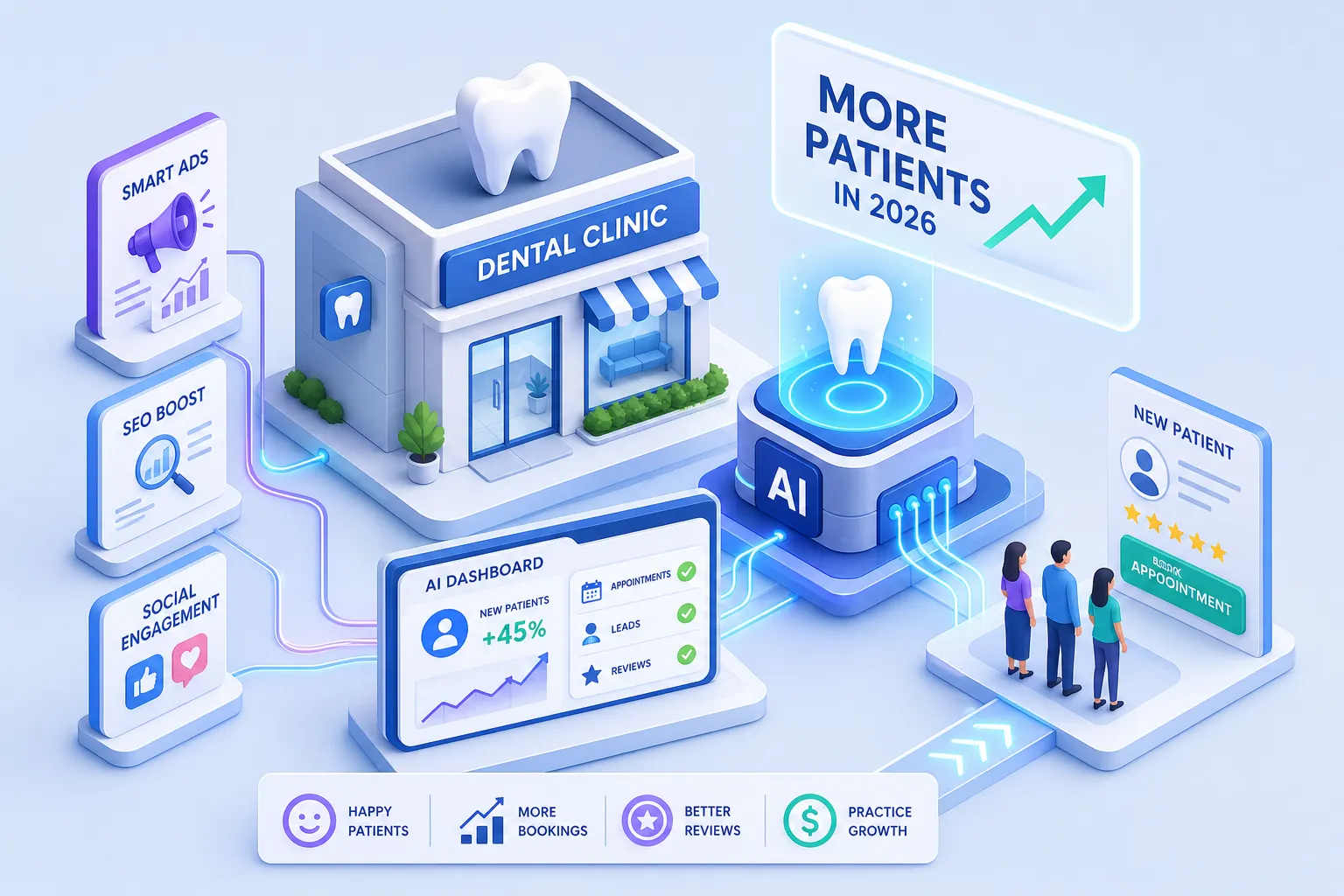
Why most dental offices are already losing patients they don't know about
The missed-call problem is bigger than it looks
About 67% of dental callers who can't reach a live person don't leave a voicemail, they call a competitor instead. Separately, research benchmarks suggest that roughly 78, 86% of callers who do reach voicemail simply hang up without leaving a message. These aren't edge cases. They're the norm, and they represent a quiet, ongoing revenue drain that most practice owners never see on a report.
The front desk is not the failure point here. A well-run front desk still has finite capacity. Calls come in during procedures, during check-outs, during lunch, and after 5 PM. The phone doesn't respect any of that. The structural mismatch between patient demand and staff availability won't be solved by hiring one more person.
What happens in the window between a call and a callback
A prospective dental patient who calls and doesn't reach anyone has already started making a decision. Research on lead response consistently shows that most prospects move on within minutes of an unanswered contact, and whoever responds first wins the appointment. The intent is real at the moment they dial. A few minutes later, that intent belongs to whoever answered.
This is why AI response tools are not a convenience feature. They're a revenue protection system. The speed of response determines whether a lead converts, and no human team can consistently match automated response times, especially at 7 PM on a Tuesday. AI patient communication for dental offices closes that gap every hour the front desk is unavailable.
How can AI help a dental office get more patients: 24/7 booking and missed-call recovery
Conversational AI that books appointments while you sleep
A conversational AI dental practice setup handles inbound inquiries around the clock through web chat, SMS, and social DMs. These AI receptionists for dentists answer common questions, collect patient information, check real-time availability, and book directly into the practice's scheduling system. This isn't a "press 1 for appointments" phone tree. It's a two-way conversation that ends with a confirmed appointment on the schedule.
The outcomes reported by vendors are substantial. Resonate AI documented a 61% increase in new-patient bookings across 15 dental practices, with two-thirds of appointments booked entirely by AI (vendor-reported figures). Bland AI reports answer rates above 95% and says AI appointment scheduling for dental offices converts 73% of calls into booked appointments, compared with 40% for callback-only approaches (vendor-reported). These tools integrate natively with Dentrix, Open Dental, and Eaglesoft, writing appointments directly into the PMS rather than a separate calendar that requires manual syncing. Note that integration depth can vary by PMS edition and version.
The practical implication is straightforward. A practice with 60 inbound calls per week that's currently converting 40% of them is booking 24 new patients. The same call volume at a 70% conversion rate is 42 new patients. That gap compounds every single week without any additional ad spend.
The missed-call recovery window
When a call goes unanswered, an auto-text sent within seconds changes the outcome of that lead entirely. The patient is still holding the phone. They haven't opened another browser tab or called a competitor yet. That brief window is the difference between a recovered lead and a lost one.
Arini reports up to 80% fewer missed calls for dental clients using automated recovery (vendor case-study result), and Goodcall cites a 12% revenue increase tied to similar missed-call automation. An AI receptionist for dentists operating on this model reaches the patient before they've decided to go elsewhere. It's not a follow-up; it's an interception. OPWDIGITAL's missed-call recovery system is built on exactly this principle, designed to engage prospects in that critical window immediately after a missed call.
Automated follow-ups and no-show reduction that run without your front desk
Pre-visit nurture sequences that protect your schedule
U.S. dental offices average 8, 15% no-show rates, with 11, 15% being common for general practices. At $300 in average production per visit, a practice losing one appointment per day to no-shows is forfeiting over $60,000 annually. That figure climbs fast for higher-volume or higher-production offices, with some practices losing $150,000 or more in unrealized production each year.
AI-powered reminder sequences combining SMS, email, and two-way texting reduce no-show rates by 20, 40% in well-designed programs. The distinction matters: one-way broadcast reminders tell patients when to show up, but two-way texting lets them confirm, cancel, or reschedule in the same thread. That surfaces conflicts early and gives the practice time to fill the slot from a waitlist. One documented implementation filled 75, 85% of canceled appointments through exactly this kind of proactive waitlist management. AI-driven patient engagement for dentists works because it removes the friction of reaching the office, patients respond in the same channel they already use.
OPWDIGITAL's pre-visit sequences are structured to meaningfully reduce no-shows by combining personalized reminders, intelligent sequencing, and real-time rescheduling capability. Results vary by practice and baseline no-show rate; the most effective programs align timing, channel, and messaging to each patient's history.
Recall automation that reactivates patients who drifted away
Every practice has a population of overdue patients. They came in once or twice, life got busy, and they stopped rescheduling. Recall automation identifies those patients, contacts them through their preferred channel, and follows up repeatedly until they book or opt out. Dental practices using AI recall systems commonly see 15, 25% reactivation within 60 days (research benchmark; results vary by baseline population and outreach cadence). That's not a marketing campaign. That's revenue that was already sitting in the practice's patient database, waiting to be recovered.
One compliance point worth stating clearly: any system handling patient outreach must include a signed Business Associate Agreement and encrypted data flows before it touches a single patient record. HIPAA applies to chatbots, voice bots, SMS platforms, and recall tools the same way it applies to any other system handling protected health information. This is non-negotiable, and it's one of the reasons practices should be selective about which vendors they work with. OPWDIGITAL operates with HIPAA-aware workflows and BAA signing as a standard requirement, not an add-on.
Reputation management and patient-acquisition ads that compound over time
Getting 5-star Google reviews without chasing patients manually
Review volume and ratings strongly influence both visibility and perceived credibility before a prospective patient ever calls. Estimates from major metro areas suggest the top-ranked dental practices carry around 175 reviews as a median, while page-two practices sit closer to 75, 100. The gap in local search visibility is not subtle, and clinical quality alone doesn't close it.
Automated reputation management works by triggering a review request text immediately after a visit, sending the patient directly to the Google review link, and following up once if they haven't responded. The friction of finding a review page on their own is removed entirely. Practices using AI for dental marketing in this way often see measurable reputation improvement within the first few months of consistent use. The compounding effect matters: more reviews at higher ratings improve visibility in "dentist near me" searches, which generates more inbound calls, which creates more opportunities to capture new patients, all without manual effort from the front desk.
Facebook and Google ads engineered specifically for dental patient acquisition
Generic social ads adapted from a retail template don't perform for dental AI patient acquisition. What works is hyper-local audience targeting, lookalike audiences built from existing patient profiles, automated creative testing, and bidding strategies optimized specifically for low cost-per-lead in a dental context. Done correctly, dental Facebook ads can generate qualified new-patient leads at $30, $80 per lead, with a cost per completed new-patient acquisition in the $150, $350 range for general dentistry, depending on geographic competition and front-desk conversion rates (figures from industry research benchmarks; results vary by market and campaign quality).
The difference between a well-built dental ad campaign and a generic one shows up in lead quality, not just volume. OPWDIGITAL builds and manages these campaigns exclusively for dental practices, with targeting logic, ad copy, and landing pages designed for one industry, so practices aren't starting from a generic template and adapting it to dentistry over time.
What it costs, how long it takes, and what to measure
Realistic budget ranges for a dental practice in 2026
Basic AI receptionist and chatbot tools, including dental answering service AI options, typically run $99, $600 per month for a single-location practice. Full conversational platforms that include recall automation, reputation management, and messaging fall in the $300, $600 per month range. Bundled AI growth platforms that include ads management, social media, and integrated automation come in at $500, $2,000 per month per location. PMS integrations may carry a one-time setup cost of $200, $500, with complex multi-location configurations running higher. Vendor quotes vary by call volume, integrations, and service level.
Implementation timelines are equally important to set expectations around. A basic AI receptionist or missed-call bot can go live in one to two days. A full conversational platform with PMS integration typically takes two to six weeks to deploy properly. Staff adoption, which is often underestimated, adds another two to four weeks after the technology is live. Plan for both the technology timeline and the team adjustment period before expecting full results.
The KPIs that tell you the AI is actually working
The metrics worth tracking are specific, and they're not difficult to pull once the systems are in place. Convert these to a standing monthly dashboard:
New patient bookings per month, measured against a pre-AI baseline
Missed-call recovery rate, the percentage of missed calls that convert into a booked appointment via auto-text
No-show rate, tracked before and after implementation
Recall reactivation percentage, patients rebooked within 60 days of outreach
Google review count and average rating, tracked month over month
Cost per new patient acquired, total marketing spend divided by completed new-patient visits
These are not vanity metrics. Each one ties directly to revenue, and together they give a clear picture of whether the investment is performing or needs adjustment. If new bookings are up but no-show rate hasn't moved, the follow-up sequences need attention. If review count is climbing but inbound calls haven't increased, the local SEO connection needs investigation. The data tells you where to look next.
How can AI help a dental office get more patients: the bottom line for 2026
The growth leaders in dental aren't necessarily the ones with the best location or the newest equipment. They're the ones that respond faster, follow up consistently, and show up where patients are searching, all without adding headcount. AI makes that achievable for a solo practitioner and a five-location group alike, but only when the tools are built for dentistry rather than adapted from a generic marketing template.
If you want to see what an AI-powered patient acquisition system looks like inside a real dental practice, OPWDIGITAL is a purpose-built starting point. It's designed exclusively for dental, operates with HIPAA-aware workflows, and integrates with major practice management systems. Reach out to the OPWDIGITAL team to walk through what an implementation would look like for your practice specifically.