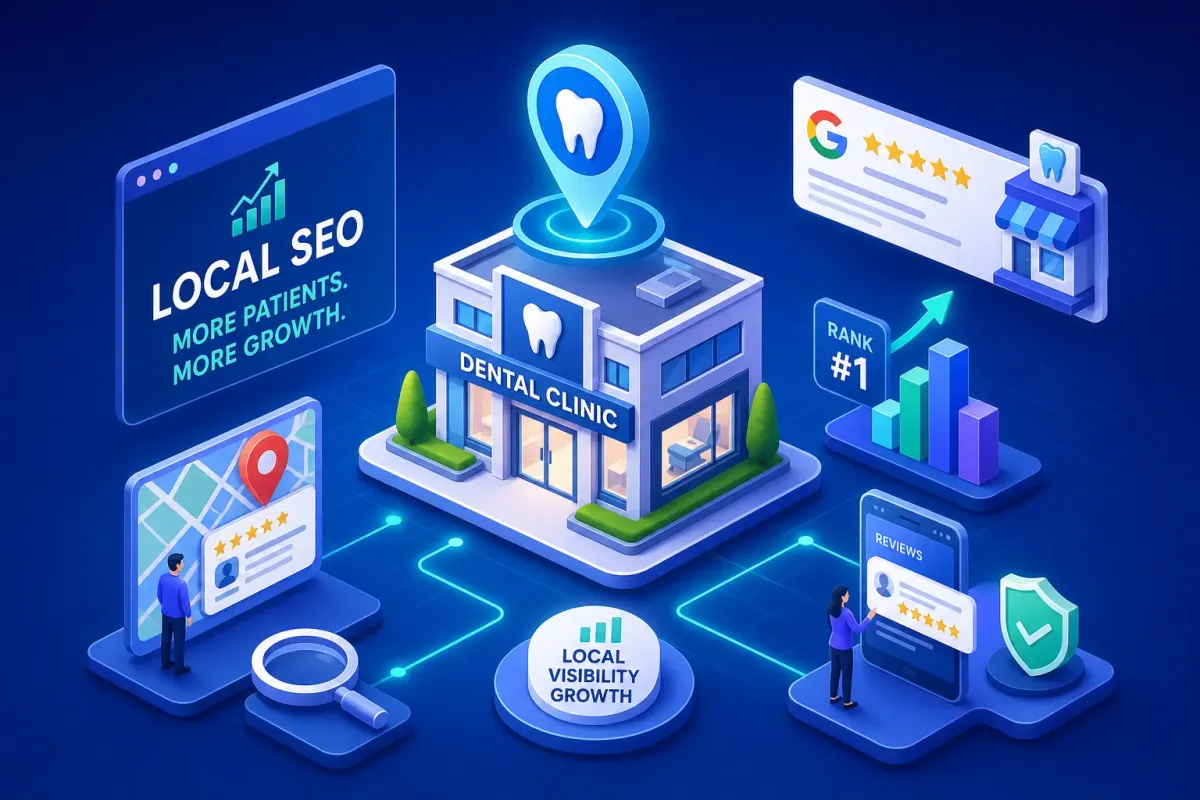
Best Local SEO Strategies for Dental Offices in 2026
Best Local SEO Strategies for Dental Offices in 2026
If you're asking what is the best local SEO strategy for a dental office, the answer starts with a hard look at local search visibility, because many practices are missing new patients before a single phone call is ever made. Not because they lack clinical skill, not because they're priced wrong, but because they're functionally invisible in local search. In 2026, the local pack is where patient decisions happen. A prospective patient searches "dentist near me," scans the top three results, reads a few reviews, and books. The whole process takes under three minutes. If your practice isn't in that three-pack, you don't exist for that patient.
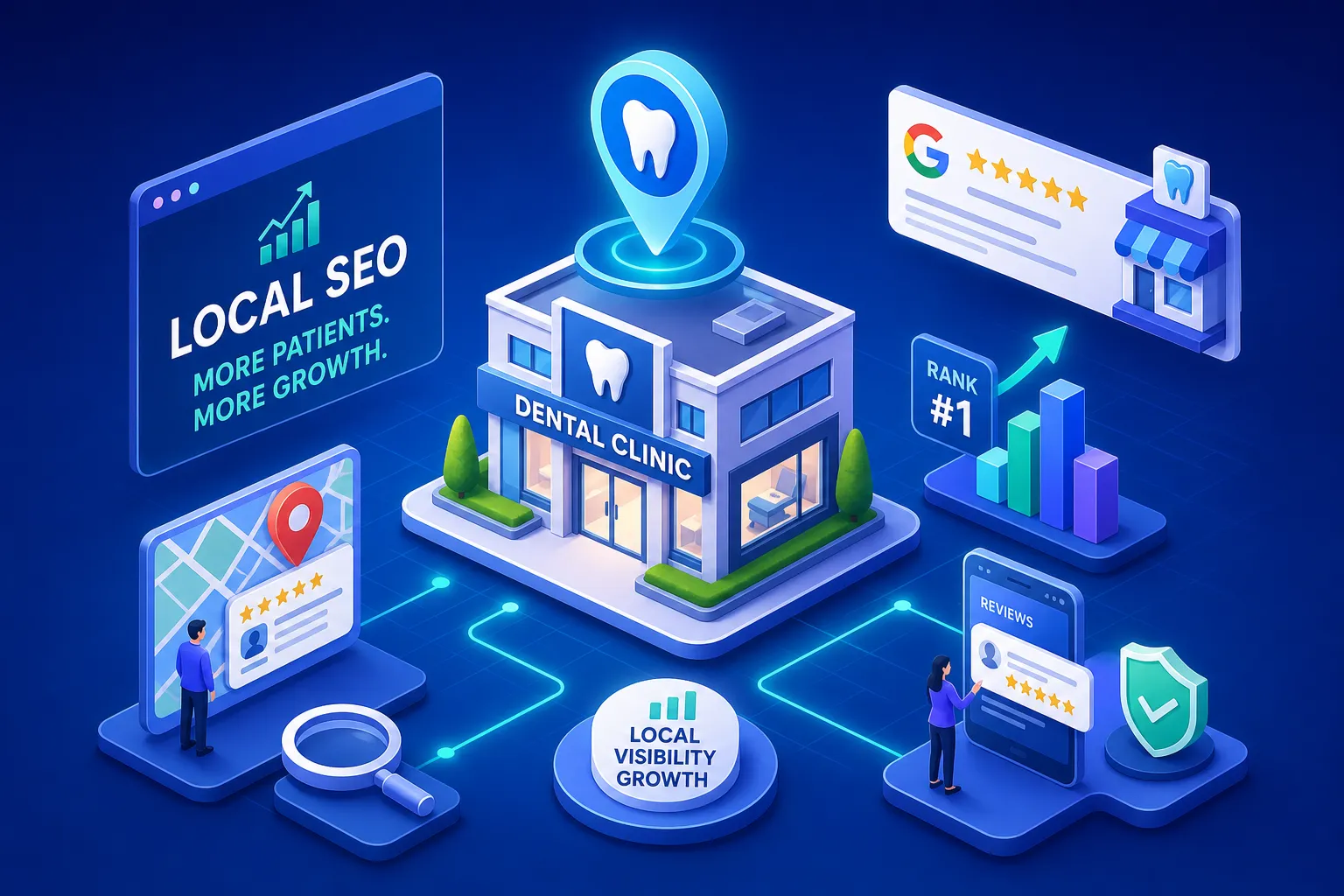
The practices winning those searches aren't necessarily the best clinics in town. They're the ones that have dialed in the fundamentals of local SEO for dentists. At OPWDIGITAL, we've watched practices go from a handful of monthly new patients to consistent double-digit growth just by fixing what local search actually rewards. None of it requires a massive budget or a full-time marketing team. It requires a prioritized strategy executed consistently.
This article covers the five highest-leverage areas of local SEO for dental offices in 2026: Google Business Profile optimization, on-site signals and schema, citation building, review generation, and performance tracking. Work through these in order and you'll have a complete foundation that compounds over time.
Why local search is your most valuable patient acquisition channel
Organic SEO for dentists is slow and competitive. Ranking on page one for terms like "dental implants" takes years and significant content investment. The local pack is a different game entirely. It runs on proximity plus controllable signals, and the competition is limited to businesses within a few miles of the searcher's location.
Google's official framework for local rankings uses three criteria: relevance, distance, and prominence. Distance is the one you can't control. The other two are almost entirely within your reach. According to Whitespark's 2026 Local Search Ranking Factors report, local ranking weight breaks down into several signal categories you can act on:
Google Business Profile signals: roughly 32% of ranking influence
Review signals: approximately 20%
On-page signals: approximately 15%
Link signals: approximately 8%
Behavioral signals (clicks, calls, direction requests): around 9%
Citation signals: about 6%
Note that these figures are survey-based estimates, not official Google percentages, and the article focuses on the most actionable subset. The categories above represent where targeted effort pays off for most dental practices.
The local pack vs. organic results: where patients actually click
For high-intent searches like "dentist near me" or "emergency dentist [city]," per 2026 BrightLocal Local Consumer Search Report data, the local three-pack pulls the lion's share of clicks. These searchers have already decided they need a dentist; they're choosing between providers, not doing research. Ranking in the local pack for these searches is worth more than a page-one organic ranking for most dental offices. The conversion path is shorter, the intent is higher, and the competition is more manageable. A practice stuck on page one organic but outside the three-pack can lose a significant portion of high-intent traffic to map-pack competitors, a real cost in appointment volume.
What is the best local SEO strategy for a dental office? Start with Google Business Profile
GBP signals account for roughly 32% of local ranking weight, making your Google Business Profile the single most impactful factor you can optimize. Many practices have a profile with significant gaps, there's a meaningful difference between a claimed profile and one that's been built out strategically.
Choosing the right categories and building out your services
Your primary category is the strongest individual signal in your entire GBP. For a general practice, "Dentist" is the correct choice. For a specialty practice, match the primary category to the specialty: "Orthodontist," "Oral Surgeon," or "Periodontist." Secondary categories should reflect services you actually offer. A general dentist adding cosmetic work might add "Cosmetic Dentist" and "Teeth Whitening Service." If you handle dental emergencies, add "Emergency Dental Service." Keep secondary categories to 3, 4 that are genuinely accurate.
For services, build out individual entries with short, specific descriptions, industry guidance suggests 8, 12 entries for specialty practices, though general practices should list all applicable services. Don't just list "fillings." Write: "Tooth-colored composite fillings that restore strength and match your natural tooth color." That specificity helps Google match your profile to more detailed searches and gives patients useful information before they ever visit your website.
Photos, posts, and Q&A: the active-profile signals most practices ignore
Google rewards active profiles. A profile that hasn't been updated in six months sends a weak signal compared to one that's consistently adding content. Industry guidance recommends adding at least 50 new photos per year. The mix should include exterior shots (so patients can recognize the building), interior photos of the reception area and operatories, team headshots, and treatment-area images. Before-and-after photos work well if you have patient consent documented.
Post to your profile regularly, twice a month is a solid baseline. Announcements, appointment availability updates, educational content, and seasonal reminders all work. Seed the Q&A section with the five questions new patients ask most often: whether you're accepting new patients, what insurance you take, whether you offer emergency appointments, what your hours are, and whether you treat children. Answer these yourself using your business account so the information is accurate and visible.
The GBP fields that quietly affect your ranking
NAP consistency matters more than most practices realize. Your name, address, and phone number on GBP need to match your website and every directory listing exactly. "Suite 200" and "#200" are not the same to Google's crawlers. Appointment booking links, attributes like "Accepts new patients," "Online appointments," and "Wheelchair accessible entrance," and current hours (including holiday hours) all contribute to both ranking and conversion. An incomplete or inconsistent profile loses patients to competitors with more complete ones.
Location pages and on-site signals that attract neighborhood patients
On-page signals carry about 15% of local ranking weight, yet many dental websites lack the specific local optimization needed to rank confidently for neighborhood searches. The typical dental website has a homepage, a services page, and a contact page. That structure doesn't give Google enough location-specific information to rank the practice for local queries.
What a high-converting dental location page includes
A strong location page leads with the city or neighborhood in both the H1 tag and the page title. The NAP on the page needs to match your GBP exactly. Embed a Google Map. Include locally relevant content: neighborhoods you serve, nearby landmarks that help patients orient themselves, and service descriptions written for that specific location. Finish with a clear booking call to action. If you have multiple locations, each needs its own dedicated page, not a shared page with a location selector.
Dentist schema markup: the practical setup
Schema markup gives search engines structured context about your practice. This is one area where dentist schema markup pays real dividends for local search. Use the Dentist type as your primary entity on the homepage and location page, not the generic LocalBusiness type. The Dentist type is more specific and better identifies your practice to search engines. Include name, address, phone, hours, geo coordinates, and your medicalSpecialty field set to "Dentistry."
For individual treatment pages, use MedicalProcedure or Service schema. For visible Q&A sections on any page, use FAQPage markup. Only use AggregateRating schema if the reviews are genuinely visible on your site; using it to mark up reviews that don't appear on the page violates Google's guidelines and can result in penalties. Validate all schema using Google's Rich Results Test before publishing.
Citation building and NAP consistency: the infrastructure layer
Citation signals account for about 6% of local ranking weight, but their real value is foundational. Inconsistent NAP across directories creates trust problems for Google and confuses patients who find conflicting information. Before you focus on building new citations, audit what's already out there and fix inconsistencies first.
The directories every dental practice needs to be listed on
Prioritize in tiers. Start with the core local platforms: Google Business Profile, Apple Maps via Apple Business Connect, Bing Places, Yelp, and Facebook. Then move to healthcare-specific directories where patients with dental intent actively search: Healthgrades, Zocdoc, Vitals, WebMD, 1-800-Dentist, and ADA Find-a-Dentist. Finally, add local authority listings: your regional Chamber of Commerce, BBB, and any local business directories with genuine authority in your market. The accuracy of your local citations for dental offices matters more than the total number of listings.
Keeping listings consistent without creating front desk work
Managing 15, 20 directory listings manually is genuinely unsustainable. Hours change, addresses get reformatted, phone numbers get updated, and none of it gets reflected across directories without a system. AI-powered dental marketing platforms like OPWDIGITAL can significantly reduce front desk workload by syncing and monitoring listings automatically, depending on integration and setup. This is one of those infrastructure problems that's easy to solve with the right tool and easy to ignore until it's quietly costing you local rankings.
Review generation that boosts rankings and books more patients
Reviews carry approximately 20% of local ranking weight. More practically, reviews are what convert a local pack impression into a phone call. Consider two practices competing for the same patient: one has 12 reviews and a 3.8-star average; the other has 80 reviews and a 4.8-star average. Consumer behavior research consistently shows patients choose the practice with more and better reviews, even when clinical quality is comparable. The challenge isn't knowing you need reviews, it's building a system that generates them consistently.
When and how to ask patients for reviews (HIPAA-safe templates included)
Timing is everything. The best moment to request a review is immediately after a positive visit, either at checkout or via a text sent within the hour. The request needs to be short and direct. Here are two HIPAA-safe templates you can use right away:
Text: "Hi [First Name], thank you for choosing [Practice Name]. If you'd like to share your feedback, we'd appreciate a quick review: [Review Link]. Your time means a lot to us."
Email: "Hi [First Name], thank you for choosing [Practice Name]. If you'd like to share your experience, please leave a review here: [Review Link]. We appreciate your support."
Keep all public responses HIPAA-safe. Never confirm someone was a patient, never reference treatment details, and never include any information that could identify a patient's health status. A safe response to a five-star review looks like this: "Thank you for your kind words and for taking the time to leave feedback. We appreciate the opportunity to serve our community." That's compliant and effective.
Why review velocity matters more than review count
A steady stream of recent reviews consistently outperforms a large but stale collection. Google weights recency heavily in its review signals. Recency and velocity often matter more than raw totals, a recent, steady stream of reviews can be more influential than an older, larger collection that's gone quiet. The goal is a consistent pipeline, not a one-time push.
How automation keeps the review pipeline running without adding workload
Practices that rely on manual review requests get inconsistent results because the ask depends on whoever is at the desk that day. When the office is busy, review requests get skipped. When staff turns over, the process disappears entirely. OPWDIGITAL's automated reputation management sends review requests within minutes of an appointment completing and is designed to integrate with practice management software, reducing the manual effort required from your front desk team. Dental office review management handled through automation keeps the pipeline running regardless of staffing variability, which is exactly the consistency that drives review velocity over time.
Measuring local SEO progress: the KPIs that tell you it's working
The biggest mistake practices make after implementing local SEO changes is waiting six months to check if anything worked. Tracking the right KPIs from day one keeps the strategy on course and helps you identify which changes are driving results.
The metrics to track in your first 90 days
Check GBP Insights weekly: profile views, direction requests, call clicks, and website clicks. These numbers tell you whether your profile is getting discovered and whether patients are taking action. In Google Search Console, watch local keyword impressions and clicks for terms that include your city or neighborhood name. Track your review count and average rating as a trend, not a snapshot. And ask every new patient how they found the practice, that direct attribution is worth more than any analytics tool.
Tools to monitor your dental practice's local search performance
GBP Insights is built-in and free, so use it from day one. Google Search Console is also free and gives you keyword-level visibility into how your website is performing in search. Whitespark and BrightLocal are both solid options for citation tracking and local rank tracking across multiple search terms and locations. Platforms like OPWDIGITAL provide dashboard-level visibility into review trends, listing health, and local search performance all in one place, which matters when you're managing multiple signals across multiple directories and don't want to log into six different tools to get a clear picture.
Frequently asked questions about local SEO for dental offices
What is the best local SEO strategy for a dental office?
The best local SEO strategy for a dental office combines Google Business Profile optimization, on-page location signals, consistent citations, and a steady review pipeline. GBP carries the highest ranking weight at roughly 32%, so start there, then layer in schema markup, citation consistency, and review automation to build a compounding presence over time.
How long does local SEO take to show results for a dental practice?
Most practices see measurable movement in GBP metrics, profile views, call clicks, direction requests, within 60, 90 days of consistent optimization. Citation cleanup and review velocity improvements can show ranking impact in a similar timeframe. On-page and schema changes typically take a bit longer to register fully.
How many reviews does a dental office need to rank in the local pack?
There's no fixed threshold, but recency and consistency matter more than total count. A practice actively generating reviews each month will generally outperform one with a larger but inactive collection. Focus on building a reliable monthly pipeline rather than hitting a specific number.
What directories should a dental office be listed on for local SEO?
Start with Google Business Profile, Apple Maps, Bing Places, Yelp, and Facebook. Then add healthcare-specific directories: Healthgrades, Zocdoc, Vitals, WebMD, and ADA Find-a-Dentist. Finish with local authority directories like your Chamber of Commerce and BBB. Accurate NAP across all listings matters more than volume.
Do dental offices need schema markup for local SEO?
Yes. Using the Dentist schema type on your homepage and location pages gives search engines clearer context about your practice specialty, hours, and location. Paired with FAQPage markup on Q&A sections and MedicalProcedure schema on treatment pages, it strengthens your relevance signals across the board.
Build a local search presence that compounds over time
So, what is the best local SEO strategy for a dental office in 2026? A layered approach that starts with GBP optimization and builds systematically from there. Start with your Google Business Profile because it carries the highest ranking weight and the most direct impact on patient decisions. Layer in on-page signals and dentist schema markup to give search engines the structured context they need. Build and clean up local citations for your dental office to establish NAP consistency across the web. Then build a review generation system that runs reliably, not just when someone remembers to ask.
Each of these tactics has a direct line to new patient appointments, not just rankings. GBP optimization drives profile clicks. Strong reviews drive phone calls. Location pages with proper schema drive neighborhood searches. Citation consistency prevents the ranking suppression that comes from conflicting business information. None of these are one-time tasks; they're systems that need to run consistently to produce consistent results.
Dental practices that invest in local search now are building a patient pipeline that compounds over time. The practices that don't will keep watching competitors rank above them in a market they're fully capable of winning. If running all of this manually feels like too much to manage alongside actually running a practice, OPWDIGITAL's AI-powered platform was built specifically to handle it for dental offices. Reach out to our team to see how it works in practice.